How Holochain works?

Any user (user agent) who wants to use a decentralized application (hApp) developed on the Holochain pattern connects to this hApp like any traditional service on internet, by entering a URL on their browser. From here the user will receive the content from one or many of the hosts.
On the other side any person who wants to host hApps can become a node (hosting agent) and be paid in HoloFuel currency for that. They can choose to host particular hApps or let the algorithm determine which applications to host.
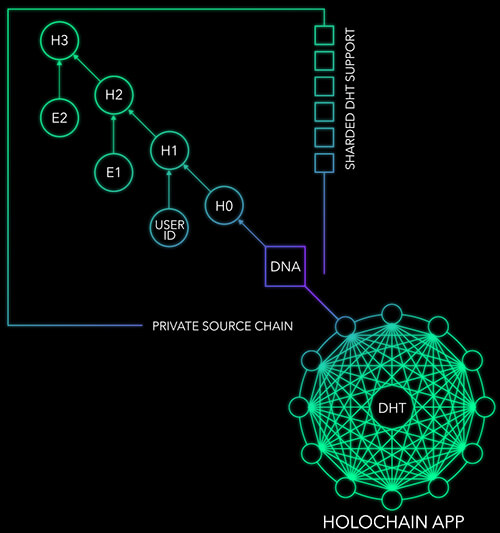
Each hApp has its own network of nodes and has an unlimited number of transactions per second because each new node (hosting agent) adds its hosting capacity and an hApp does not require a full synchronization between nodes, apart from the normal gossip of a DHT. But there's no sync problem, because there's no global state. All state is local, that means a transaction is written to only the source chains of the agents who are party to the transaction, and then shared with some of the hosting agents depending on the redundancy factor.
So, if the redundancy factor for the DHT is 50, there are only 50 nodes who need to validate the transaction, even if there are 50,000 nodes running an hApp. The portion of work each node has to do actually gets smaller as the number of nodes grows instead of larger (as for global consensus systems).
In the background the hosting agents manage automatically the correct data distribution in order to avoid overloading one of these nodes and they also check the redundancy factor in order to keep the minimum of nodes with these data.
Invest in HoloFuel
Become an early investor in $HOT, a very promising project which could be the future of local and global fractal currencies. Welcome to the future of decentralization.
Buy HoloFuel